
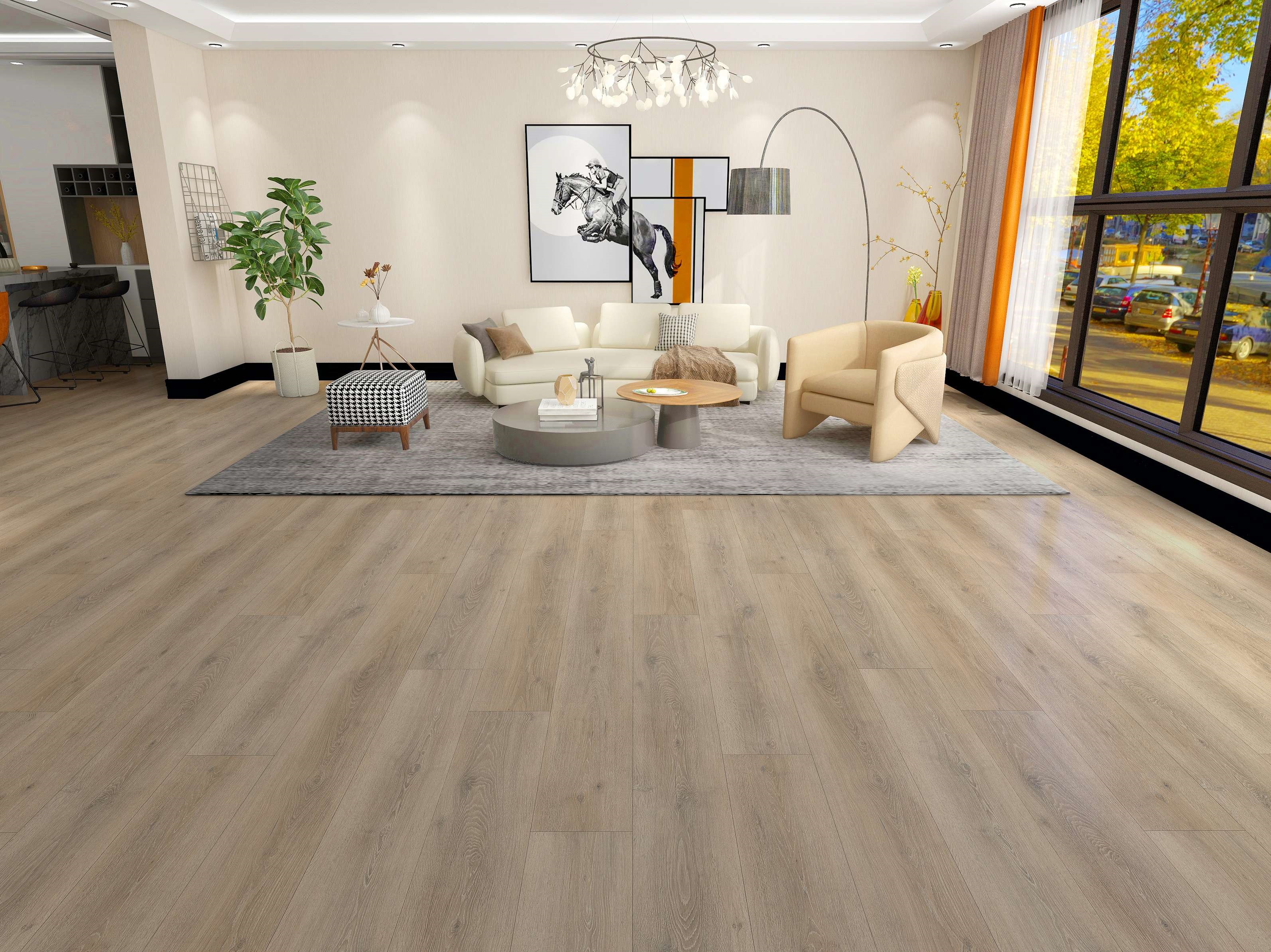
Walk into any flooring showroom and you'll find SPC and laminate sitting side by side, sometimes at nearly identical price points, both with photographic layers that convincingly mimic hardwood. It's an easy mistake to treat them as interchangeable. They're not.
Here's what actually separates them — and how to know which one belongs in your home.
What they have in common
Both SPC and laminate are multi-layer "floating floor" systems — they click together and sit over your subfloor without glue or nails. Both use a photographic image layer to replicate wood grain, stone, or tile. Both are significantly less expensive than real hardwood. And both are available in a wide range of styles that, at their best, are genuinely difficult to distinguish from the real thing.
Where they diverge: the core
The difference lives in what they're made of underneath.
SPC (Stone Polymer Composite) has a rigid core made from limestone, polyvinyl chloride, and stabilizers. The result is a dense, dimensionally stable plank that doesn't expand, contract, or flex under temperature changes. It's completely impervious to water — not just resistant, but genuinely waterproof through and through.
Laminate has a high-density fiberboard (HDF) core — essentially compressed wood fiber. This makes it warmer and slightly softer underfoot than SPC, but it also means water is its enemy. Laminate can handle splashes, but prolonged exposure causes the core to swell, delaminate, and warp.
The waterproof question
This is the deciding factor for most rooms.
If you're installing in a kitchen, bathroom, laundry room, mudroom, basement, or any space with regular moisture exposure — SPC is the only sensible choice. Laminate in a bathroom is a gamble you'll eventually lose.
For bedrooms, home offices, dining rooms, and living areas where moisture is never a concern, laminate is a perfectly valid option — and often a more comfortable underfoot experience.
Feel and acoustics
SPC's dense stone core means it transmits sound and feels slightly harder underfoot. Most SPC products include an attached underlayment to soften this, but it's still firmer than laminate.
Laminate's wood-fiber core absorbs more impact and deadens sound more naturally. If you're renovating an upper floor and noise transmission to the unit below matters, laminate has a natural edge.
Durability
For surface durability — resistance to scratching, scuffing, and staining — both materials perform well when you buy quality. Look for:
- Wear layer thickness on SPC (0.5mm / 20 mil is residential standard; 0.7mm / 28 mil for heavy use)
- AC rating on laminate (AC3 for residential, AC4–AC5 for commercial or very heavy traffic)
SPC wins on impact resistance — its rigid core doesn't dent under heavy furniture or dropped items the way laminate can.
Subfloor requirements
SPC tolerates minor subfloor imperfections better because its rigidity spans small gaps and humps. Laminate requires a flatter, more prepared subfloor — small variations telegraph through to the surface over time.
The bottom line
| | SPC | Laminate | |---|---|---| | Waterproof | Yes — 100% | No — moisture-sensitive | | Feel underfoot | Firm, dense | Warmer, slightly softer | | Best rooms | Kitchen, bath, basement, all areas | Bedroom, living room, office | | Subfloor tolerance | Better | More demanding | | Acoustics | Add underlayment | Naturally quieter |
Choose SPC if there's any chance of moisture, if you have radiant heat, or if you want something genuinely maintenance-free.
Choose laminate if moisture is never a factor and you want the warmest, most realistic feel at the lowest price point.
When in doubt: order samples of both. Put them on your actual floor, under your actual lighting. The right choice usually becomes obvious within about 30 seconds.