
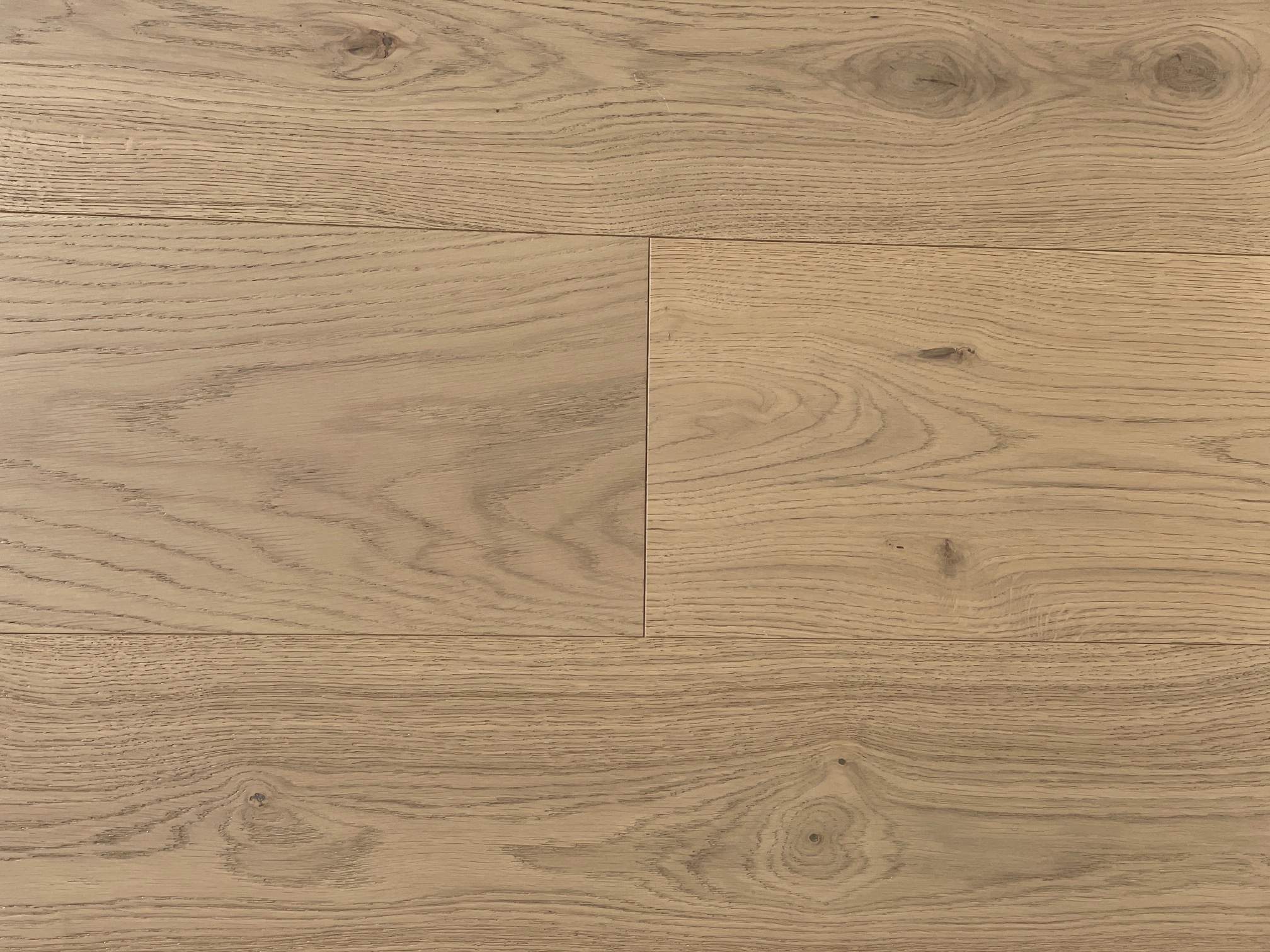
Solid hardwood floors are beautiful. They're also a product designed for the climate of a New England farmhouse — steady humidity, mild temperature swings, no radiant heat, no concrete slabs. Southern California is not that.
If you're planning hardwood floors in an LA home, here's what you need to know about why engineered is almost always the right call.
The California climate problem
Wood is hygroscopic — it absorbs and releases moisture from the surrounding air, expanding and contracting as it does. This is the defining physical characteristic of the material, and it's why solid hardwood flooring requires such careful climate management.
In Southern California, two things conspire against solid wood:
The dry-season low humidity. Santa Ana conditions can push interior humidity below 20%. At those levels, solid hardwood shrinks, and wide planks develop visible gaps between boards. These gaps close back up when humidity rises, but repeated cycles cause cumulative stress on the wood and finish.
The concrete slab. The majority of Southern California homes are slab-on-grade construction — no basement, no crawl space, just a concrete slab poured directly on grade. Concrete holds moisture and transmits it upward. Solid hardwood glued or nailed over concrete will eventually cup, buckle, or fail. Most solid hardwood manufacturers void warranties for slab installations for exactly this reason.
Add radiant heating — increasingly common in high-end LA renovations — and the conditions become even more challenging for solid wood.
Why engineered solves these problems
Engineered hardwood is real wood. The surface layer — the part you see and walk on — is genuine hardwood veneer, milled from the same species as solid flooring. The difference is in the core construction.
Instead of a single piece of wood, engineered hardwood bonds multiple layers of wood fiber in alternating grain directions — the same principle as plywood. This cross-ply construction dramatically reduces movement: the layers work against each other when the board tries to expand or contract, keeping it dimensionally stable.
The results for California specifically:
- Can be installed over concrete. Most engineered hardwood products can be glued or floated directly over a concrete slab. The stable core handles the moisture transmission that would destroy solid wood.
- Tolerates low humidity. Where a 7-inch solid plank might gap ¼ inch in dry conditions, a comparable engineered plank shows almost no movement.
- Compatible with radiant heat. The stable core handles the temperature cycling that causes solid wood to fail over time.
The aesthetic is identical
This is the part that matters most to most homeowners: you cannot tell the difference.
The surface layer of engineered hardwood is genuine wood — the same grain, the same texture, the same response to light, the same warmth underfoot. A quality engineered floor with a 2mm+ European oak veneer, properly finished and installed, is indistinguishable from a solid floor by everyone except a flooring professional who gets on their knees with a loupe.
The misconception that engineered is somehow inferior to solid is a category error. The engineered construction is a response to a real engineering problem — moisture movement — not a cost-cutting measure.
What to look for in Southern California
Veneer thickness. 2mm and above gives you real character in the grain and, if you ever want to lightly refresh the surface, some refinishing margin. Avoid products under 1.5mm — they're engineered for budget, not longevity.
Core construction. More plies is better. A 5+ ply core provides more stability than a 3-ply. Look for manufacturers who are specific about their core construction.
Width. Engineered construction is what makes wide planks practical. Don't let concerns about movement talk you into narrow planks — properly engineered wide planks are completely stable.
Finish. Wire-brush or hand-scraped finishes hide the minor movement that any floor will experience in a Southern California climate. High-gloss finishes show everything.
One more thing: CARB2
California Air Resources Board Phase 2 (CARB2) certification limits formaldehyde emissions from composite wood products. It's a California-specific requirement, and any flooring product sold in California should carry it. All Portofino products are CARB2 certified — look for this on any product you consider.
Southern California is one of the best places in the world to have beautiful hardwood floors. You just need to choose the right product for the actual conditions. Engineered hardwood, properly specified, is that product.